
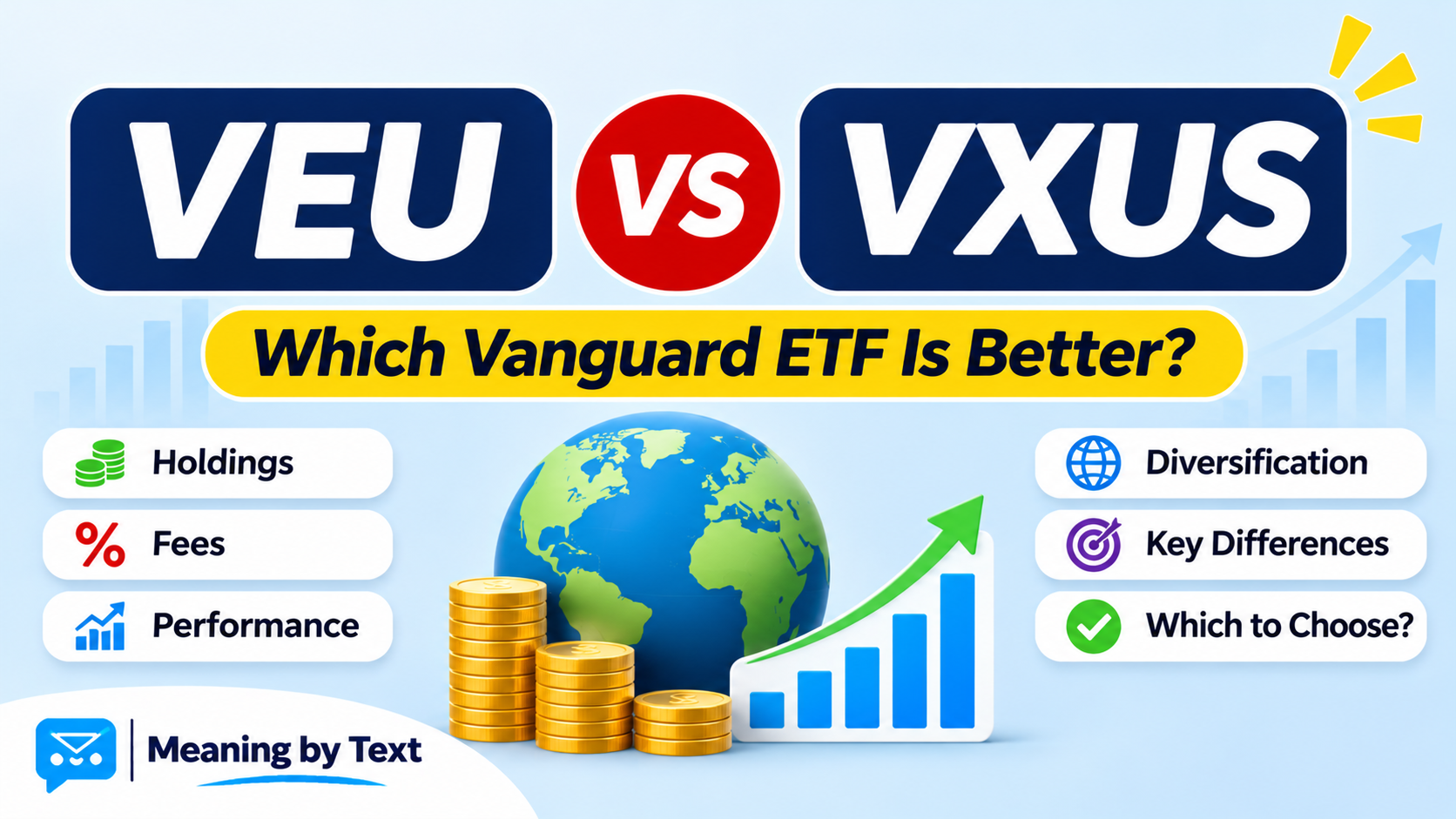
Choosing between VEU vs VXUS can be confusing because both Vanguard exchange-traded funds offer international stock market exposure at low costs. However, their investment strategies have one important difference. VEU focuses mainly on large and mid-sized international companies, while VXUS also includes smaller businesses. Understanding their fees, holdings, diversification, and risks can help investors choose an ETF that fits their long-term goals.
What Is VEU?
The Vanguard FTSE All-World ex-US ETF (VEU) tracks the FTSE All-World ex US Index.
It invests primarily in large and mid-cap companies located outside the United States.
VEU provides exposure to developed and emerging markets, including Japan, China, the United Kingdom, and Canada.
Its expense ratio is 0.04% as of 2026, making it an affordable option for international investing.
What Is VXUS?
The Vanguard Total International Stock ETF (VXUS) tracks the FTSE Global All Cap ex US Index.
Unlike VEU, VXUS includes large, mid-sized, and small companies across international markets.
This broader approach gives investors exposure to thousands of businesses in both developed and emerging economies.
VXUS has an expense ratio of 0.05%, which remains highly competitive among international equity ETFs.
VEU vs VXUS: Key Differences
Both ETFs share similar investment objectives, but their coverage differs.
| Feature | VEU | VXUS |
|---|---|---|
| Fund Provider | Vanguard | Vanguard |
| Expense Ratio | 0.04% | 0.05% |
| Stock Coverage | Large and mid-cap | Large, mid, and small-cap |
| US Stocks | Excluded | Excluded |
| Emerging Markets | Included | Included |
| Dividend Payments | Quarterly | Quarterly |
| Investment Style | International index | Total international index |
The biggest distinction is VXUS’s additional exposure to smaller international companies.
VEU vs VXUS Expense Ratio
Investment expenses affect long-term returns, particularly when investors hold ETFs for many years.
VEU charges approximately $4 annually for every $10,000 invested.
VXUS costs approximately $5 annually for the same investment amount.
The difference is only $1 per year on a $10,000 portfolio.
Therefore, the choice should depend more on investment coverage than this small fee difference.
VEU vs VXUS Performance
VEU and VXUS often deliver similar investment performance because they own many of the same major international companies.
However, VXUS includes additional small-cap exposure, which can influence returns during different market conditions.
When smaller international companies perform strongly, VXUS may benefit.
Conversely, VEU may outperform when larger companies lead the market.
Neither fund guarantees higher future returns, and past performance does not predict future results.
Which ETF Offers Better Diversification?
VXUS provides broader company-size diversification because it includes small-cap stocks.
VEU remains widely diversified across international countries, sectors, and established businesses.
Both funds can complement a US-focused investment portfolio.
However, holding VEU and VXUS together creates considerable overlap because their largest investments are similar.
VEU vs VXUS: Which Should You Choose?
VEU may suit investors who prefer exposure to established international companies and slightly lower annual fees.
VXUS may suit investors seeking more complete international market coverage, including smaller businesses.
Both ETFs carry stock market, currency, geopolitical, and emerging-market risks.
For long-term investors, VXUS offers broader diversification, while VEU provides a simple, low-cost alternative.
The VEU vs VXUS decision ultimately depends on your preferred exposure, existing investments, and financial goals.
